
WorldFish
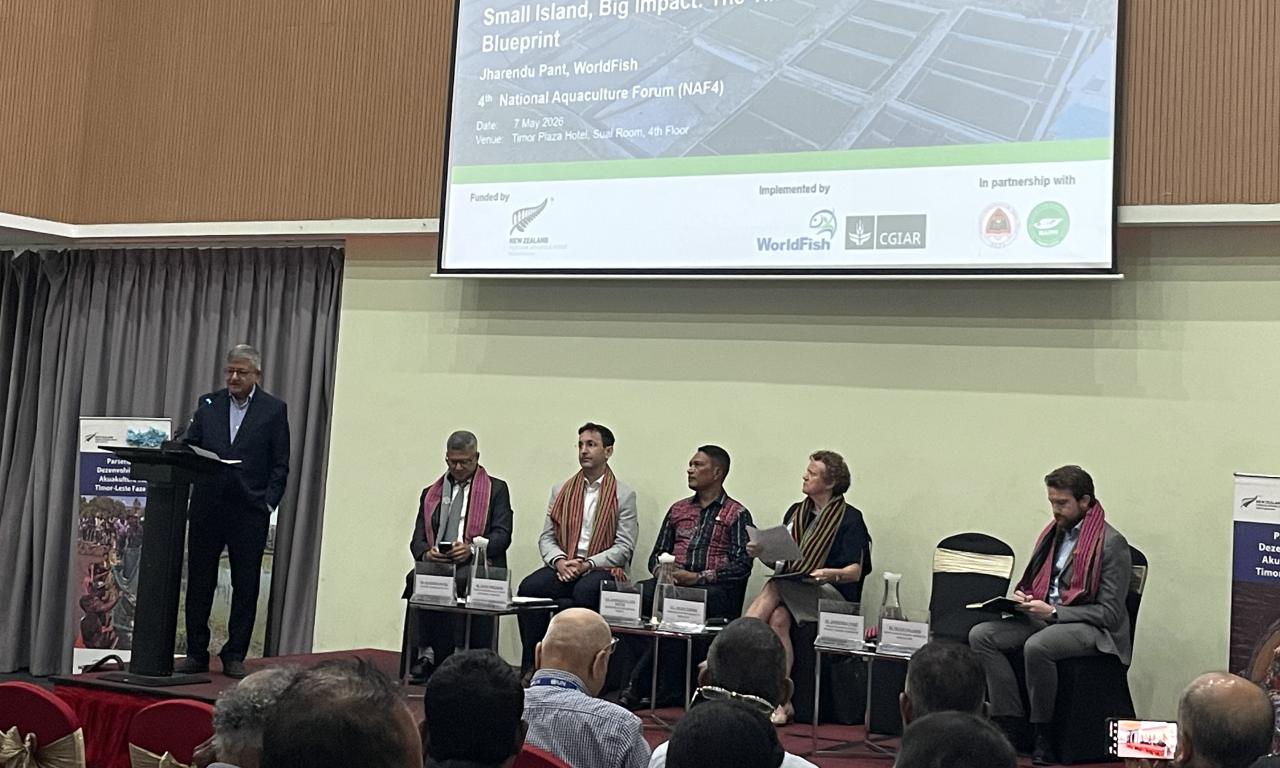
Over 150 stakeholders have gathered in Dili, Timor-Leste, for the National Aquaculture Forum to celebrate a decade of progress in aquaculture development and to strengthen partnerships for scaling the sector.
The forum marks a decade of the Partnership for Aquaculture Development in Timor-Leste (PADTL), supported by the New Zealand Ministry of Foreign Affairs and Trade since 2014. PADTL1 ran from 2014 to 2020, while PADTL2 runs from 2020 to 2026. The program is implemented by WorldFish in partnership with the Ministry of Agriculture, Livestock, Fisheries, and Forestry (MALFF).
Bringing together government officials, development partners, researchers, private sector stakeholders, fish farmers, and value chain actors, the forum highlights Timor-Leste’s transition over the past decade from early pilot initiatives to a scalable, more integrated national aquaculture model that has strengthened livelihoods, improved nutrition, and enhanced resilience. Direct and indirect beneficiaries now produce more than 900 tonnes of GIFT tilapia each year, valued at more than USD 3 million, helping increase the availability of fresh, nutritious fish in local markets and farming households.
H.E. Domingos da Conceição dos Santos, Secretary of State for Fisheries, MALFF:
“Over the past decade, aquaculture development—particularly the scaling of GIFT tilapia—has generated significant impact for rural communities, contributing to stronger livelihoods and a measurable increase in per capita fish consumption. Sustained collaboration between government, the private sector, and development partners will be critical to accelerating progress toward our national targets for fish production and consumption.”
H.E. Helen Tunnah, New Zealand Ambassador to Timor-Leste:
“The Government of New Zealand has been pleased to support the development of aquaculture in Timor-Leste, and we thank our partners who have delivered this program – the Government of Timor-Leste and WorldFish. Aquaculture has improved access to nutrition and improved people's livelihoods, and enabled communities to create jobs and incomes in support of their economic and social development.”
Dr. Jharendu Pant, Senior Scientist at WorldFish and PADTL2 Project Leader:
“Timor-Leste demonstrates how a holistic approach, long-term investment, and strong partnerships can transform small-scale aquaculture systems into a viable and scalable sector. The PADTL model provides a clear pathway for scaling aquaculture within and beyond Timor-Leste, diversifying livelihoods, strengthening food systems, creating jobs, and building resilience to climate change. There is growing interest from several countries across Asia-Pacific and Africa in adapting and scaling this model.”
The forum showcases key achievements of the PADTL program, which has significantly increased fish productivity from just 1 tonne per hectare in 2010 to 17 tonnes per hectare per cycle currently, with two production cycles per year. These gains have been supported by the expansion of GIFT hatcheries, improved seed systems, strengthened farmer capacity, and the development of market linkages. The sessions further highlight innovations in feed, private sector engagement, and opportunities to scale aquaculture nationwide.
A recent national fish consumption survey also demonstrated a clear increase in per capita fish consumption, from 6.1 kg per person per year in 2011 to 8.7 kg in 2025, pointing to broader progress in fish availability, access and consumption.
High-level participation, with the Vice Prime Minister of Timor-Leste, H.E. Francisco Kalbuadi Lay, as Chief Guest and senior representatives from the World Bank, Food and Agriculture Organization of the United Nations (FAO), and other key development partners as Special Guests at the forum, underscores the strong and growing recognition of aquaculture as a strategic sector for Timor-Leste’s economic transformation, food security, and climate resilience.
The event also provides a platform for private sector actors and value chain stakeholders to share experiences and identify opportunities for collaboration, investment, and innovation.
As Timor-Leste looks ahead, the forum highlights the next phase of aquaculture development—scaling sustainable practices, strengthening partnerships, and creating new opportunities for inclusive growth.
ENDS
NOTES TO EDITOR
About the Ministry of Agriculture, Livestock, Fisheries, and Forestry (MALFF)
The Ministry of Agriculture, Livestock, Fisheries, and Forestry is the government department responsible for the development of the rural sector in Timor-Leste. Approximately 75 percent of the population live in rural areas; the majority of which derive their livelihoods from agriculture. Despite the importance of the sector, and significant investments made by successive governments, the sector’s performance has been mixed and productivity levels remain low. The ministry therefore works to develop a sustainable, competitive and prosperous agricultural sector that can reduce poverty, ensure food and nutrition security, and promote employment and economic growth in the agricultural sector.
About the New Zealand Ministry of Foreign Affairs and Trade (MFAT)
The PADTL project is funded by MFAT as part of the New Zealand International Development Cooperation (IDC) program. The IDC program delivers New Zealand’s official support for developing countries, with a particular focus on the Pacific Islands region. The purpose of New Zealand’s IDC program is to develop shared prosperity and stability in the Pacific and beyond, drawing on the best of New Zealand’s knowledge and skills. The program supports sustainable development in developing countries to reduce poverty and contribute to a more secure, equitable and prosperous world.
About WorldFish
The PADTL project is led by WorldFish, an international research organization working to transform aquatic food systems to reduce hunger, malnutrition and poverty. As a member of CGIAR, WorldFish works with partners to co-develop science, innovations and evidence for policy to support inclusive, resilient and sustainable food systems. For more information, please visit www.worldfishcenter.org
About CGIAR
CGIAR is a global research partnership for a food-secure future. CGIAR science is dedicated to reducing poverty, enhancing food and nutrition security, and improving natural resources and ecosystem services. Its research is carried out by 15 CGIAR Centers in close collaboration with hundreds of partners, including national and regional research institutes, civil society organizations, academia, development organizations and the private sector. For more information, please visit www.cgiar.org
Cover photo: Dr. Jharendu Pant presents at the 4th National Aquaculture Forum in Dili. Also pictured are H.E. Domingos da Conceição dos Santos, Secretary of State for Fisheries, and H.E. Helen Tunnah, New Zealand Ambassador to Timor-Leste. Photo: Shwu Jiau Teoh/WorldFish.