Esther Magondu

Esther Mweru
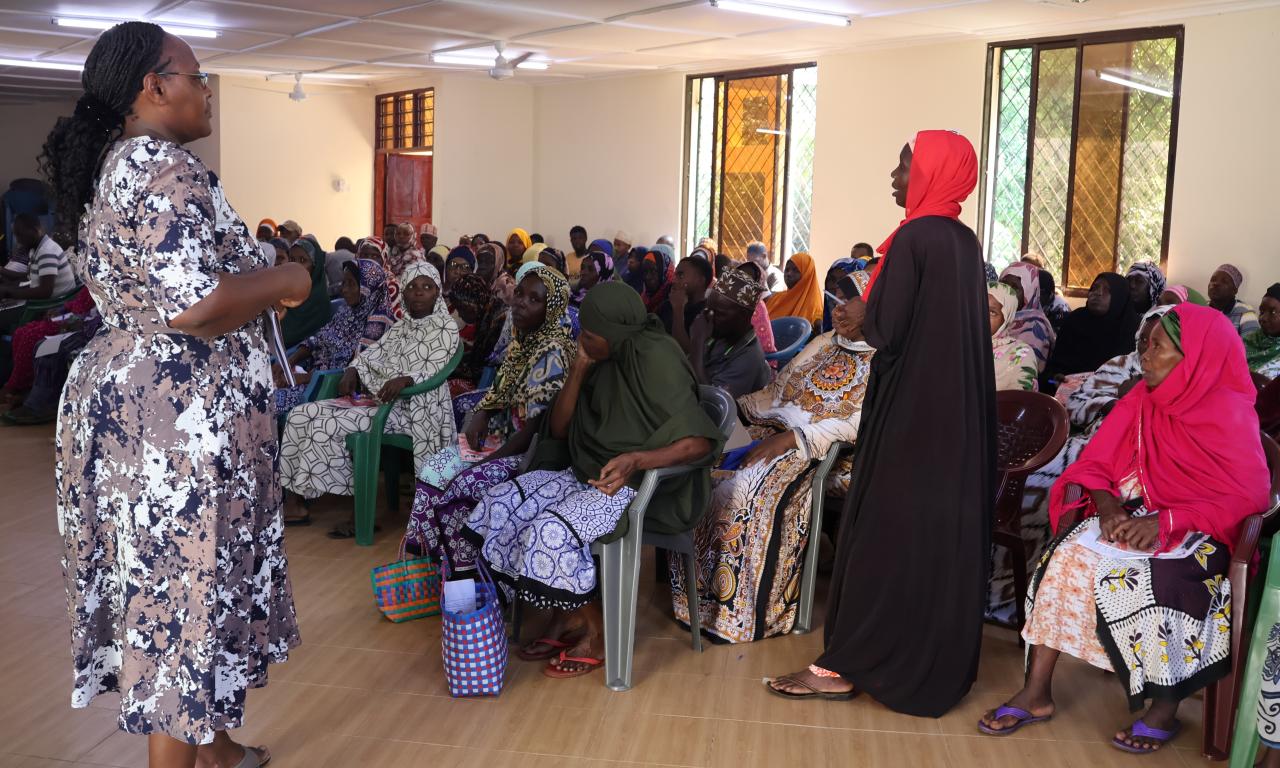
On 27–28 March 2026, 100 seaweed farmers (69 women and 31 men) from Kibuyuni, Kijiweni, and Changai came together in Shimoni, Kwale County, for a two-day training under the Asia–Africa BlueTech Superhighway (AABS) project led by WorldFish.
More than a technical workshop, it created space for farmers to reflect on the realities of seaweed farming and connect production challenges with practical business and market solutions.
A Space for Reflection and Shared Experience
Women’s strong engagement stood out. They were the majority in attendance and among the most active contributors throughout the discussions. They spoke openly about the challenges they face, including adequate drying of seaweed, maintaining quality, finding buyers, and organizing production and sales.
Their engagement showed that seaweed farming is not a marginal activity in these coastal communities. For many women, it is a livelihood pathway that fits local realities, can be pursued close to home, and has the potential to generate income if key constraints are addressed.
When Production Meets Market Realities
The first day focused on production, post-harvest handling, and farm management. Farmers were introduced to seaweed farming in the wider blue economy, market trends, and the importance of good farming practices in improving quality and returns.
As discussions opened up, women and men quickly connected these topics to their own experiences. One issue came through consistently across the discussions. Farmers can produce seaweed, but selling it remains difficult.
For many, post-harvest handling and market access continue to limit returns.
“Drying has been a major challenge, and at times we harvest but end up keeping the seaweed at home because there is no market at the time, This training has helped me understand that if we improve drying, maintain quality, and work more closely as a group, we can sell better and improve our returns," said Tima Omari, one of the seaweed farmers who participated in the training.
Training on best practices covered site selection, farm layout, planting materials, maintenance, harvesting, and drying. Farmers immediately connected this guidance to local gaps. Participants from Kijiweni raised the shortage of drying racks as a major challenge, explaining that drying seaweed on the ground lowers quality and makes it harder to reach better-paying markets.
A session on seaweed farm management and climate resilience explored disease, environmental stress, predation, and changing water conditions. This led to a useful exchange of farmer knowledge.
Participants referred to lessons from Pemba, Tanzania, where seaweed is dried on raised racks rather than on the ground, and where affected seaweed may be moved to areas with stronger water flow instead of being taken home immediately. These examples helped farmers compare practices and reflect on what adaptations may be possible in Kwale.
From Farming to Running a Business
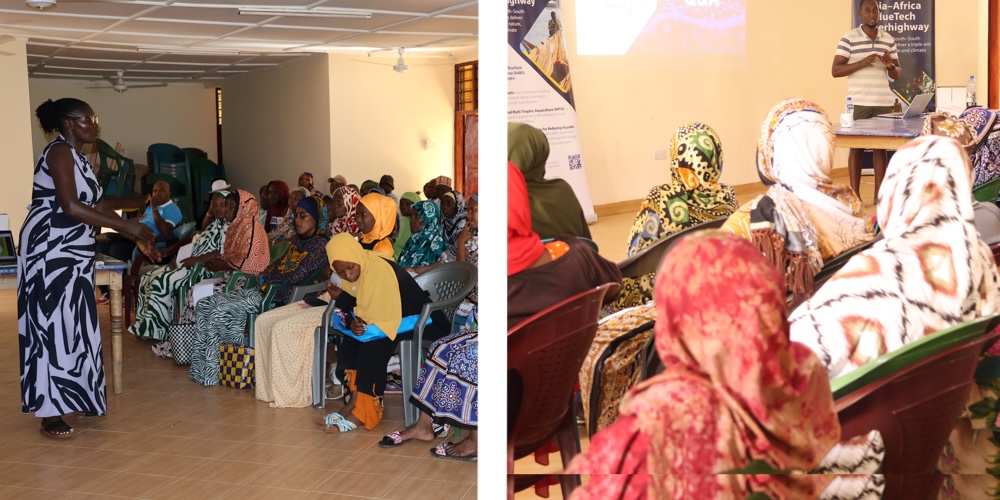
The second day shifted more deliberately to business skills. Farmers were trained on the seaweed value chain, enterprise thinking, financial record-keeping, and cooperative marketing. This moved the conversation from how to farm to how to make seaweed farming work profitably.
As farmers reflected on these practices, record-keeping stood out as a key gap.
“Before this training, we were not keeping records well, so it was hard to know whether we were making profits, Now I have learned that I need to record what I harvest, what I sell, and what I spend so I can better track how my farming is performing,” said Mwanaisha Nassoro, a seaweed farmer participating in the training.
Farmers discussed how to track inputs, labour, harvests, sales, and profits, and how stronger organization could improve bulking, bargaining power, and access to more reliable buyers offering competitive prices. For many women, this was especially relevant, as weak markets and poor returns cannot be solved through production alone, but require stronger market access and better collective organization.
Setting a Clearer Pathway Forward
Under AABS, the aim is to make seaweed farming a more viable livelihood for the women, men, and young people involved in the sector. Training is one part of that, but farmers also need practical support to improve quality, organize production, and reach more reliable markets.
The next step is to support farmers to apply what they learned in practice, particularly in record-keeping, proper drying, quality improvement, and group marketing. Follow-up support will focus on strengthening coordination across Kibuyuni, Kijiweni, and Changai, while facilitating linkages to buyers. Continued mentoring and exchange between the groups will help farmers put these lessons into practice and strengthen women’s and youth participation in seaweed farming and marketing.
Cover photo: Seaweed farmer shares expectations for the training. Photo: WorldFish Kenya.